Law firms · Switzerland and Spain
Websites for law firms in Switzerland and Spain.
For firms advising private clients, families and companies in Zurich, Geneva, Lugano and Basel, and in Madrid, Barcelona, Málaga and Palma. And for those whose clients live on both sides of the border. A website designed so that someone looking for a lawyer knows at once who they are dealing with and what it costs to begin, and trusts you with the matter, at any hour and in their language.

Concept · Orvalle Avvocati Abogados
The highlights.
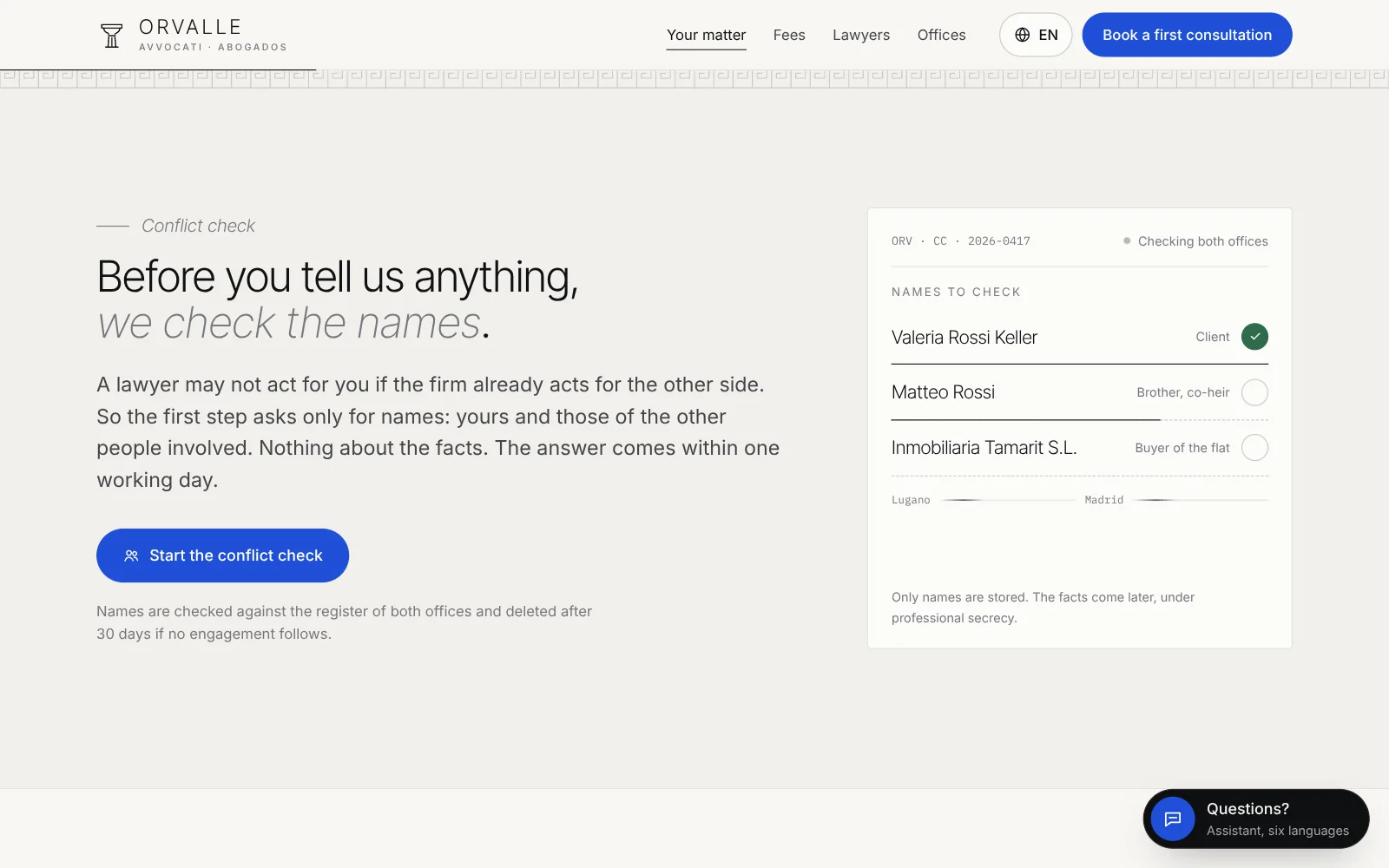
First only the names, no facts yet. The firm checks for conflicts in both offices.
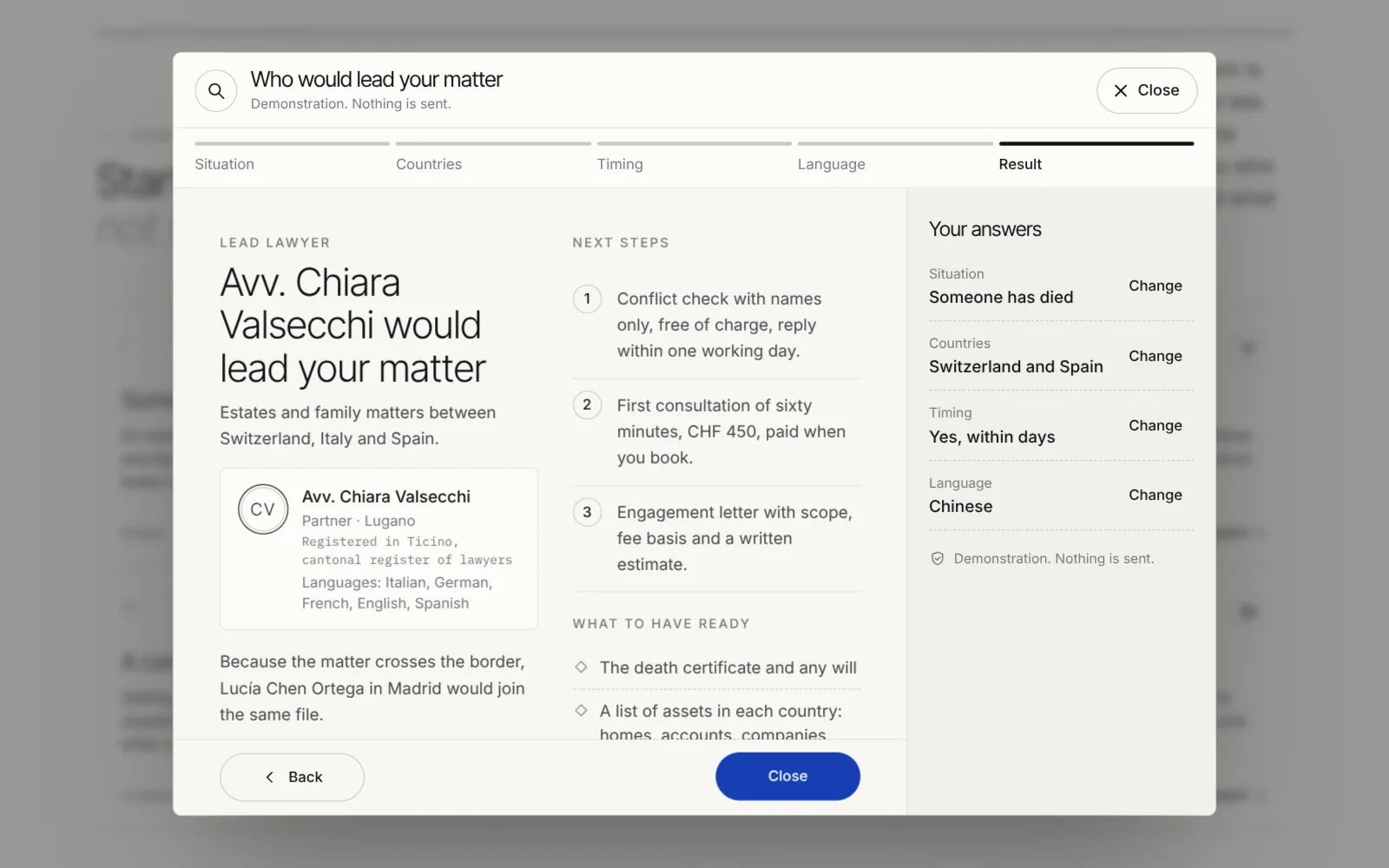
Four short questions, and the site suggests who would lead the matter. With the next steps and what to have ready.
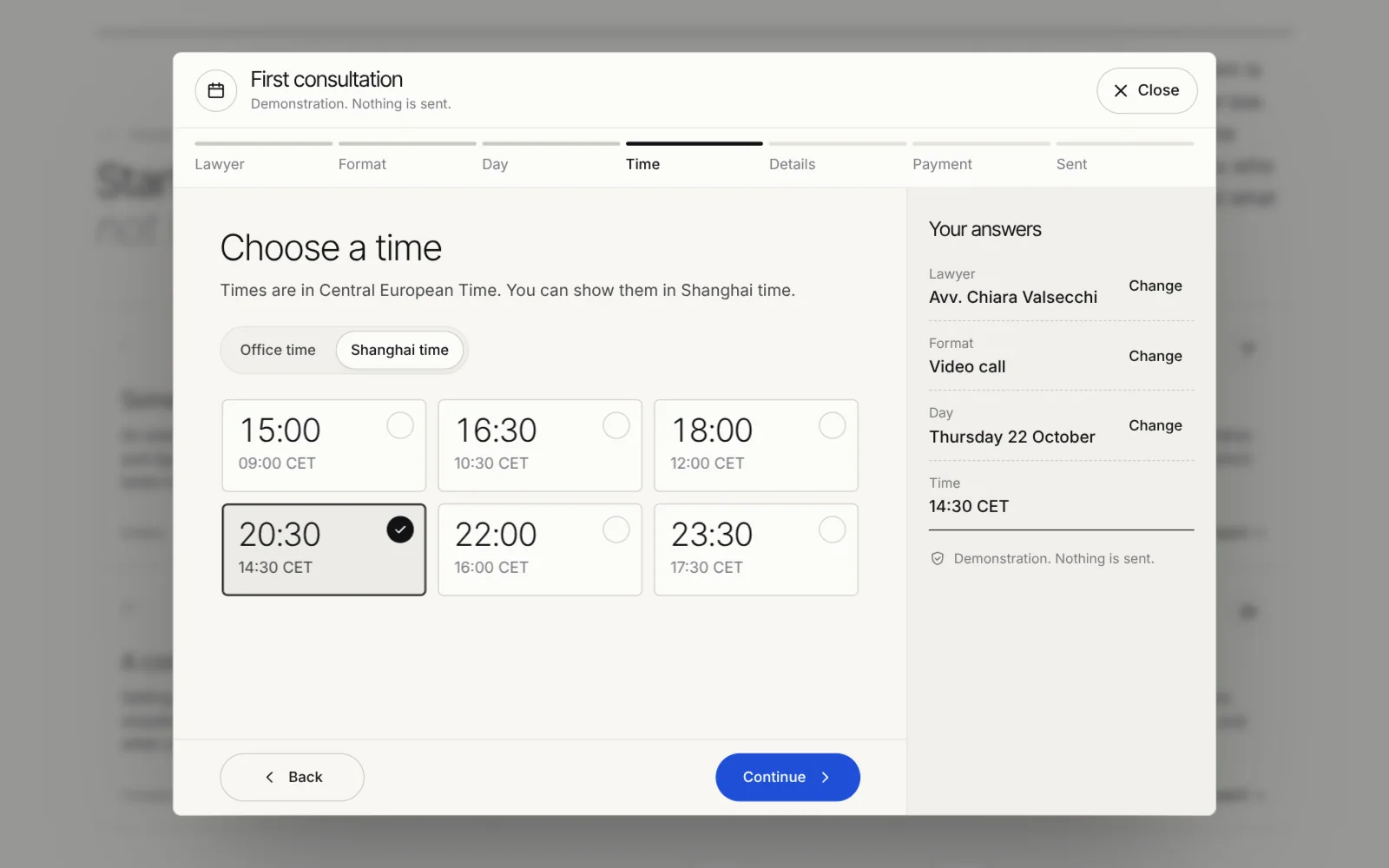
The first consultation is booked and paid in the same window. With the times also shown in Shanghai time.
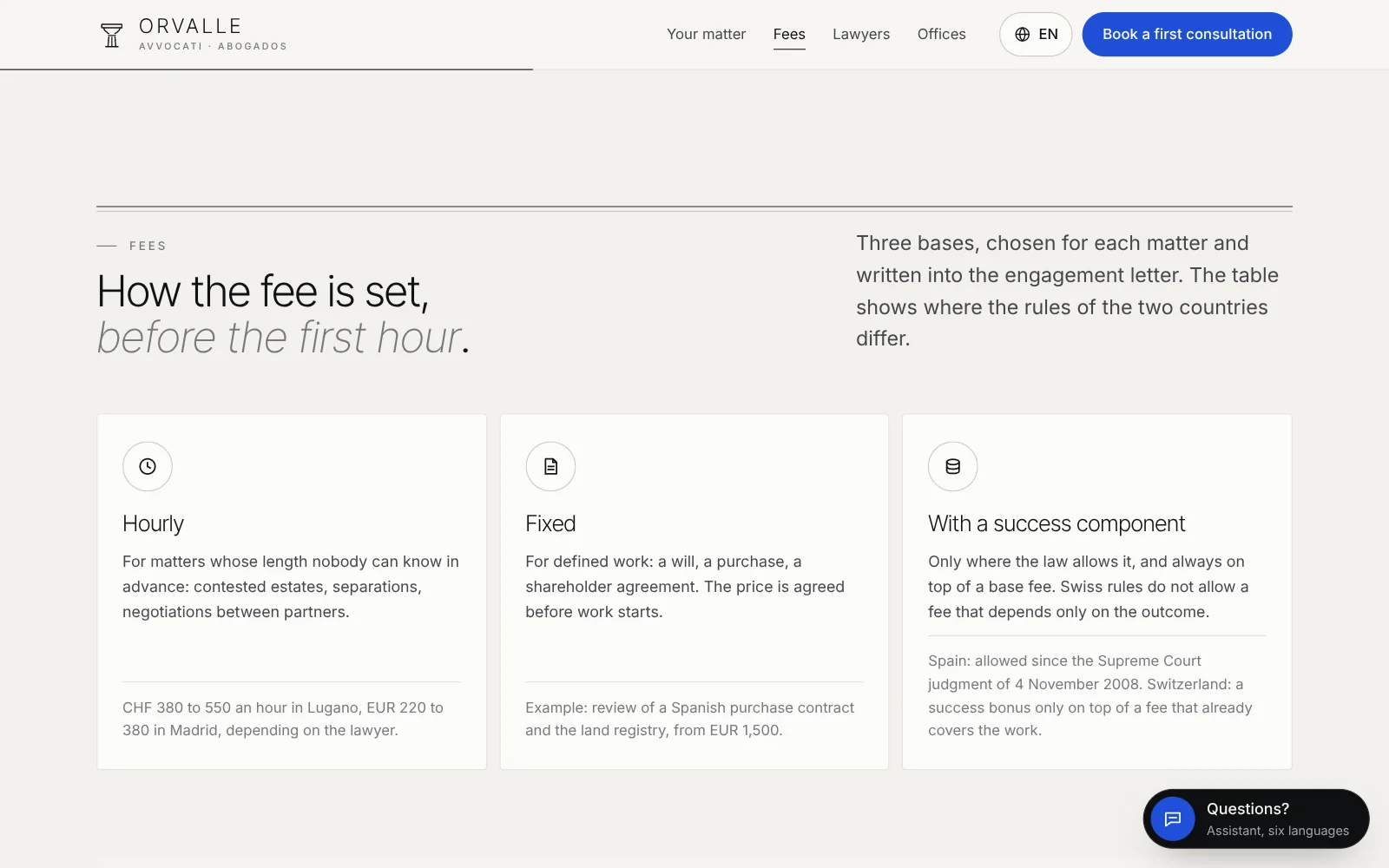
How fees are set in Switzerland and in Spain, side by side. With the article that governs it in each country.
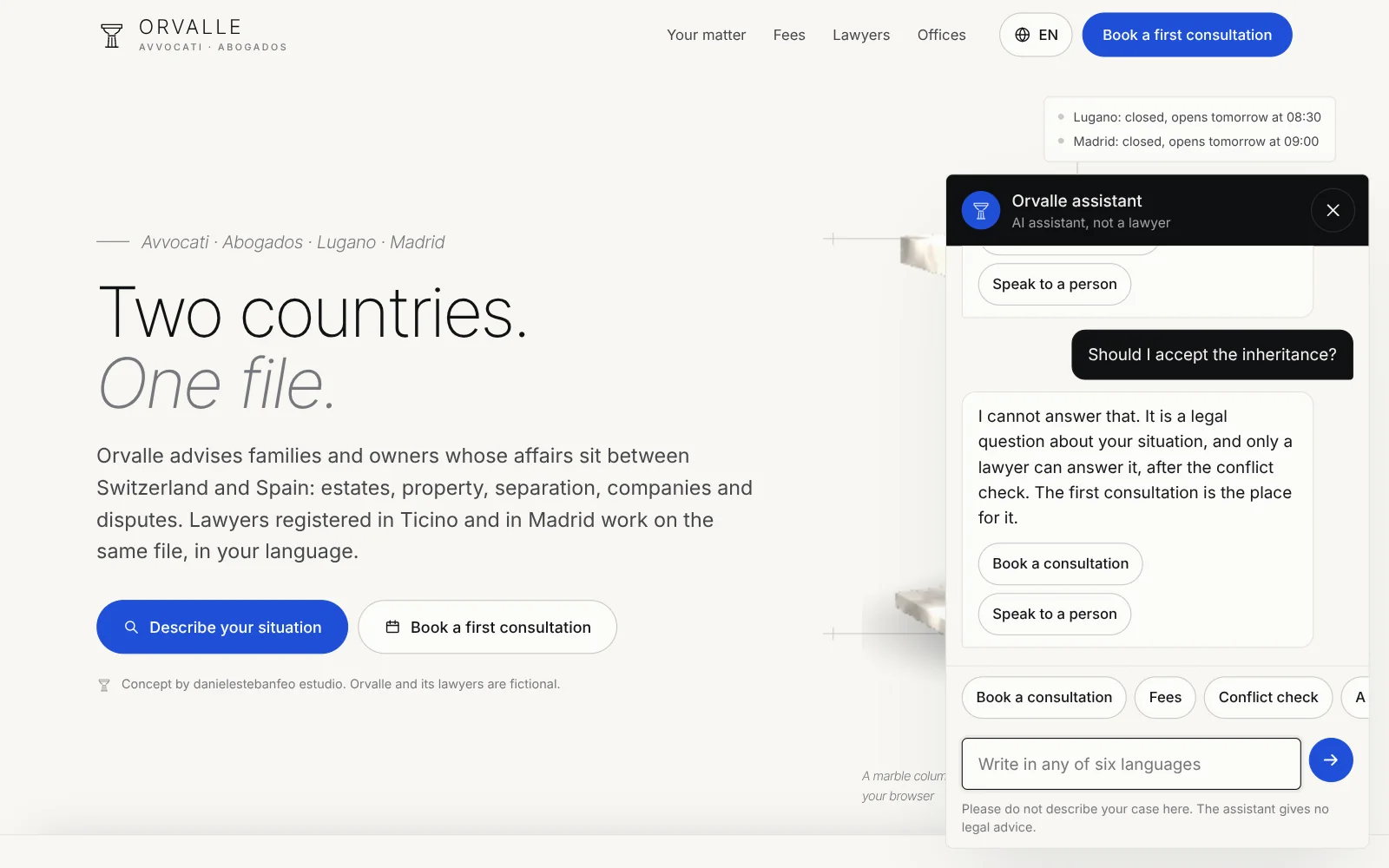
The assistant answers in six languages and says it is not a lawyer. Faced with a legal question, it offers a consultation or a person to talk to.
They choose you before they call.
Hardly anyone looks for a law firm by the name of a field of law. They look for their problem: an estate with assets in two countries, a partner leaving the company, a separation, a house bought from abroad. Often they arrive with a name given by someone they trust, and the first thing they do is open your website, usually on a phone, to see who would handle the matter, whether you know their situation and what it will cost to start.
In this sector, the law decides part of the design. In Switzerland, the federal Lawyers Act allows advertising as long as it stays objective and meets the public’s need for information. In Spain advertising is free, but it may not promise results, encourage litigation or name clients without their consent. In January 2025, the Swiss Federal Supreme Court upheld a warning against a Fribourg lawyer who had sent tenants who did not know him letters offering a free 45-minute first consultation.
And the first contact is delicate. Before hearing a case, a firm has to know it does not already act for the other side, and a form that asks people to “tell us about your case” receives confidences before it knows. In Spain, since December 2024, the Right of Defence Act also gives clients the right to be told, simply, how fees are set, what the costs are and who their lawyer is, with their bar association and number.
That is why I do not design a law firm’s website as a brochure with twenty practice areas and a phone number. I design it as the first stretch of the engagement: names first, facts later, with fees in writing and documents kept away from email.
In figures.
- 6
languages your concierge answers in, Chinese included.1
- 24/7
answering, booking and qualifying, outside your opening hours too.1
- ≤ 2.5 s
to show what matters on a phone.2
- 1
person to talk to, from the first call to the launch.
- 1 With Signature + AI Concierge.
- 2 Largest Contentful Paint, the “good” threshold of Google’s Core Web Vitals, measured on mobile before delivery.
What your website has to solve.
Names before facts.
A conflict check that asks only for the names of the parties and reaches your team ready to run. Nobody describes their case until your firm knows it can listen.
A first consultation booked and paid.
Day, time, format and lawyer, chosen on the website itself, with the lawyer’s name and bar association or cantonal register visible before payment. No call to arrange another call.
Fees explained before work starts.
Hourly, fixed price or retainer: the basis for each type of matter, written to be understood, and an indicative range your team then confirms in writing.
Advertising your bar would sign off.
Objective copy, no superlatives, no promised outcomes, and no client logos or reviews without written consent. Trust comes from the profiles: real titles, registration, working languages and publications.
The client’s language and time zone.
German, French, Italian and English in Switzerland, Spanish and English in Spain, and simplified Chinese for those writing from Asia. With each office’s public holidays and time zone, so nobody books a day the office is closed.
Confidentiality, on the website too.
Forms that ask for the minimum, documents uploaded to an encrypted space instead of travelling by email, and the website hosted in Switzerland. What clients entrust to you passes through no more hands than necessary.
How I build it.
Script before design.
I decide with you what each visitor must understand and do on each page, from their situation to the paid consultation, and I write it before drawing anything.
Bespoke design.
No templates, no scales, no gavels, no columns. The website starts from your firm, your people and the way you work, with photographs of your actual lawyers.
Tools and AI concierge.
With Signature + AI Concierge, an assistant answers in six languages, day and night, explains how your firm works, books the first consultation and hands the lawyer a summary. It says it is an AI and never gives legal advice.
Fast on mobile.
Google’s Core Web Vitals in green, measured on mobile before delivery. With the 3D scene and the transitions too.
Hosted in Switzerland.
On servers in Switzerland, under Swiss data protection law. I sign the confidentiality agreement your firm asks for, and I design the website so that I have no access to what your clients send you.
One point of contact.
Your partners and management deal with me, from the first call to the launch.
Studio concept · the brand is imaginary, the work is real
See it in a concept.
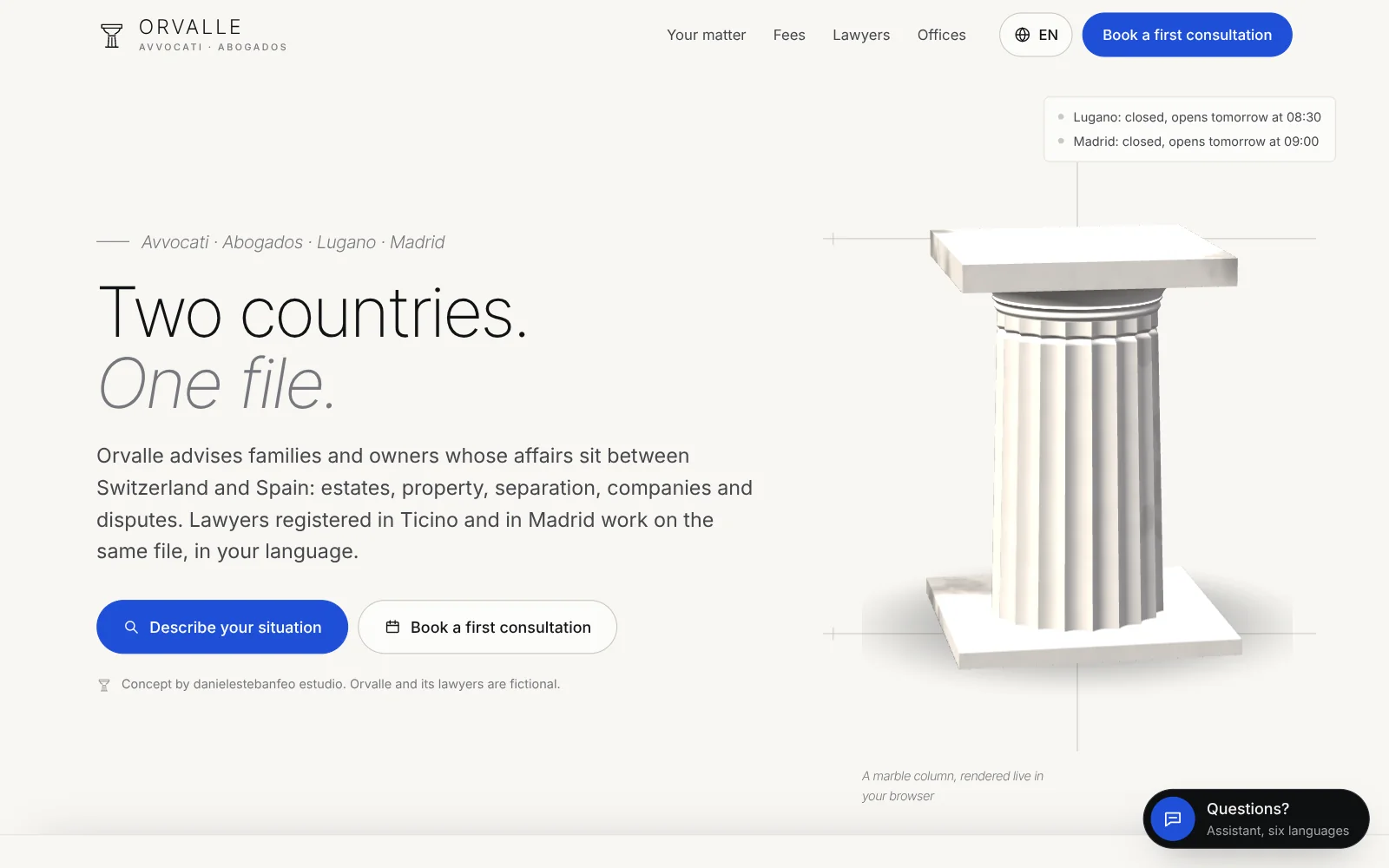
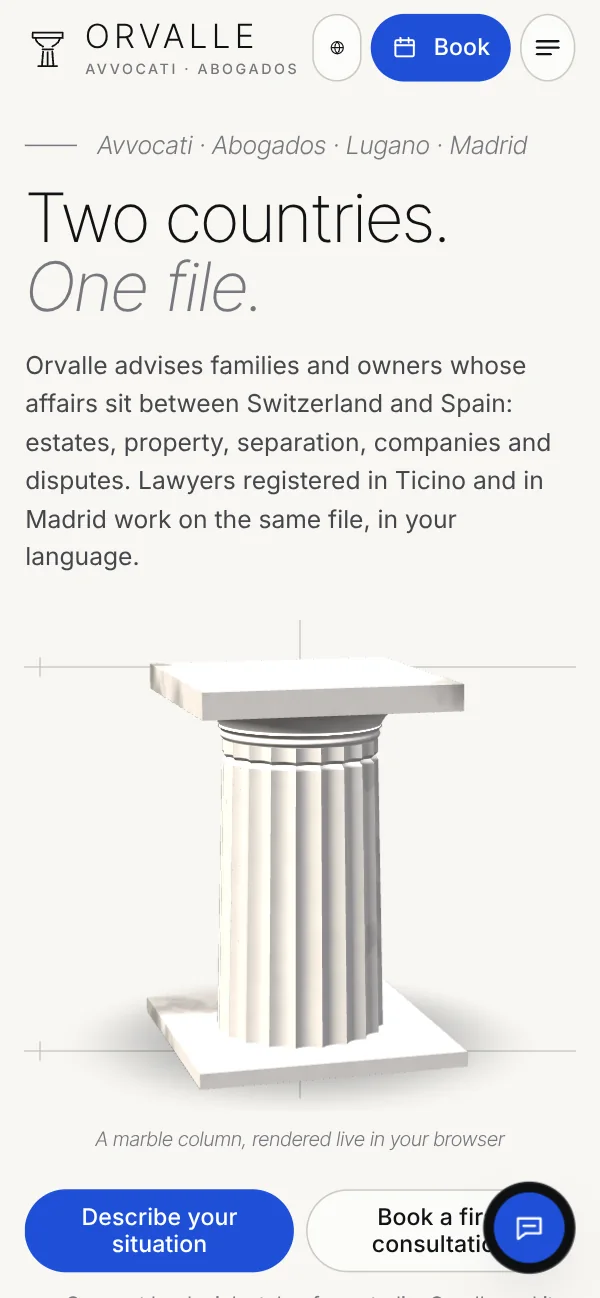
Orvalle is a fictional firm in Lugano and Madrid, made to show the standard: a 3D marble column that turns with the mouse and hairline drawings that trace themselves as you scroll, a conflict check that asks only for names, the first consultation with each office’s holidays and time zone, a fee estimator comparing Switzerland and Spain, and an AI concierge that gives no legal advice. In Italian, Spanish, German, French, English and Chinese.
See Orvalle ›Where to begin.
Everything begins with a study that is deducted afterwards: the diagnostic or, if you only want to automate the website you already have, the automation assessment. Then, whichever service your firm needs.
- AuditStrategic DiagnosticWhere every website project begins. I study your website, SEO, competitors and how you win clients, we go through it in a 50-minute call, and the plan is yours to keep.CHF 3,500›
- AutomationAutomation AssessmentFor the website you already have. I study how it is built and what can be automated with AI, and set out in writing how and at what fixed price, within a week.CHF 2,000›
- RescueRescue SprintFor the website that is already costing you clients. Key pages, speed, SEO and lead capture, put right in three to four weeks without starting over.From CHF 6,000 to 9,000›
- WebsiteWeb EssentialThe essentials of your website, made to the same standard. Up to eight pages, in two languages and Chinese, in five or six weeks, at a fixed price.From CHF 13,000›
- WebsiteWeb SignatureA new website, designed from scratch in your clients’ languages, with online booking, local SEO and hosting in Switzerland. Eight to ten weeks, at a fixed price.From CHF 20,000›
- Website + AISignature + AI ConciergeThe Web Signature plus an AI concierge that answers, books and qualifies in six languages, on the website and on WhatsApp. Ten to twelve weeks, at a fixed price.From CHF 32,000›
- ContinuityOngoing PartnershipYour website, maintained and improved every month after launch. Local SEO, visibility in AI assistants, content and the concierge, with a monthly report and review with me.From CHF 3,500 a month›
Questions
What I am often asked.
If your question is not here, we will answer it in the diagnostic call.
May a law firm advertise on its website?
Yes, within limits that differ by country. In Switzerland, federal law allows it as long as it stays objective and meets the public’s need for information; in Spain it is free, within the General Statute of the Legal Profession and the Code of Conduct. I design and write within those limits, and your firm reviews every text before it goes live.
Do we have to charge for the first consultation?
That is your firm’s decision. The website lets clients book and pay for it, or book it without payment if you prefer. What the Swiss Federal Supreme Court found unlawful in 2025 was something else: offering a free consultation by letter to people who had not asked for one.
Does it work with our practice management software?
The website connects to the calendar, case management or billing system you already use, so a paid consultation opens the client record without anyone copying data by hand. I do not ask you to change systems. How it integrates is something I check in the Strategic Diagnostic, before fixing the price.
Who sees what our clients send us?
Your firm. The website is hosted on servers in Switzerland, under Swiss data protection law, and also complies with the GDPR. Documents go to an encrypted space, not to email. If it has an AI concierge, I set out in writing which services are involved and where they process data before switching it on.
Which languages can the website be in?
Your clients’. In Zurich or Basel it usually starts with German and English; in Geneva or Lausanne, with French and English; in Lugano, with Italian; in Spain, with Spanish and English. And simplified Chinese, with its own typography and date and price formats. Laws and titles are written the way each country says them.
How much does it cost and how long does it take?
A Web Signature starts at CHF 20,000 (€21,400) and takes eight to ten weeks; Signature + AI Concierge starts at CHF 32,000 (€34,300) and takes ten to twelve. A fixed price, with 50/30/20 payments. If what you need fits into fewer pages, Web Essential starts at CHF 13,000 (€13,900), to the same standard. First comes the Strategic Diagnostic, CHF 3,500 or €3,750, deducted in full.
Your client has already chosen you. Your website decides whether they write.
Begin with the Strategic Diagnostic. I study your website, your competitors and how your matters reach you, and we go through it together in a 50-minute call.